
Reviewed · UNESCO WORLD HERITAGE TOURS
Kathmandu UNESCO Heritage Tour with Local Food Tasting
Kathmandu’s best introduction may be found in the sharp contrast between Swayambhunath’s hilltop calm and the crowded lanes below. This five-hour private tour links the Monkey Temple, Kathmandu Durbar Square, and Asan Market, then adds a serious tasting session rather than a token snack.
I like the way the route joins major sights with ordinary city life. I also like that guides such as Rajan explain the religious meaning behind the temples instead of simply pointing at them. The main consideration is pace: with three substantial stops, food tastings, and transport between sites, this is a full half-day rather than a slow, unhurried walk.
Key points to know before you book
- Swayambhunath gives you a hilltop view of Kathmandu Valley, along with Buddhist shrines, prayer flags, monks, and monkeys.
- Kathmandu Durbar Square brings living tradition into the tour, including the Kumari, Kal Bhairav, and Swet Bhairav.
- Asan Market is a working neighborhood market, not a staged shopping stop, with spices, grains, clothing, brassware, and produce.
- The food list is unusually generous, covering momo, samaybaji, yomari, bara, chatamari, gwaramari, and lassi.
- The private format allows some flexibility, and the guide can adjust the schedule within the five-hour outing.
- The $64 price includes the practical extras, including transport, entrance fees, food, a bottle of water, an English-speaking guide, and government taxes.
Why this five-hour route works so well
Kathmandu can feel confusing at first. Sacred courtyards hide behind shopfronts, market lanes twist without warning, and a short distance on the map can take time by car. This tour gives you a useful structure without reducing the city to a string of photo stops.
You begin from Thamel or another stated Kathmandu pickup point. Thamel is the city’s main visitor district, full of trekking shops, handicrafts, restaurants, and hotels. From there, the tour moves toward Swayambhunath, then into the historic center, and finally to Asan Market and its surrounding food lanes.
The order matters. You first get a broad view and a sense of Kathmandu’s religious life. You then move into royal history and Newar architecture before finishing among traders, shoppers, cooks, and pedestrians. By the end, you have seen the city from above, from its ceremonial center, and at street level.
Because this is a private group, you are not tied to the rhythm of a large coach party. That helps when you want extra explanation at a shrine or need a little time with a dish. Still, five hours is not enough for long visits at every site, so expect a compact tour with plenty packed into each hour.
More UNESCO Heritage Tours in Kathmandu:
- Private Kathmandu Sightseeing Tour | UNESCO World Heritage sites
★ 5.0 · 756 reviews - Kathmandu: Full Day 7 UNESCO Tour with Lunch – Private/Group
★ 5.0 · 415 reviews - Kathmandu: Full Day Top 4 UNESCO Tour with Lunch – Private/Group
★ 5.0 · 269 reviews
Swayambhunath: prayer flags, monkeys, and valley views
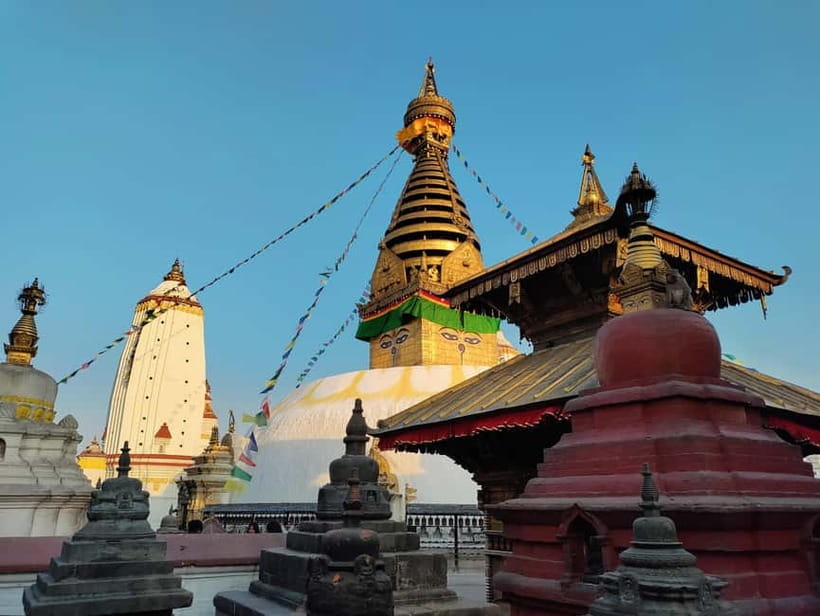
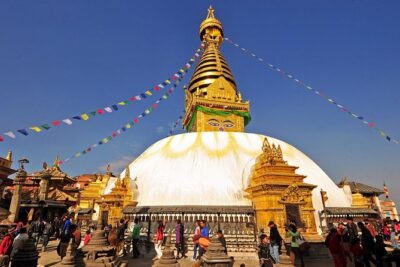
Swayambhunath is the emotional high point for many visitors. The stupa sits on a hill above Kathmandu, and the setting gives you an immediate break from the city’s traffic and noise. Prayer flags move in the wind, monks chant, and the famous painted eyes of the stupa look out across the valley.
The site is also known as the Monkey Temple. Monkeys are part of the character of the place, but they are still wild animals, so keep food and loose belongings secure. The tour allows about an hour here, enough for a guided visit and time to take in the setting.
Your guide’s role is important at Swayambhunath. A stupa is not just a large white dome with a golden tower. The symbols, prayer wheels, shrines, and offerings carry meaning for Buddhist and Hindu worshippers. An English-speaking guide can connect those details to Nepal’s religious traditions and help you understand why this place remains active rather than serving only as an old monument.
You should also make room for the view. From the hilltop, Kathmandu spreads across the valley below. The panorama helps you understand the city’s scale and position before you return to its narrow streets. Bring a camera if you like, but give yourself a quiet moment too. The peaceful mood is one of the strongest parts of the stop.
Swayambhunath does require time on a hill and around a temple complex. The supplied details do not specify the exact walking conditions or accessibility arrangements, so ask the operator if that matters for you. Comfortable shoes are a sensible choice for any walking tour in Kathmandu.
Kathmandu Durbar Square and the living Kumari tradition
The next major stop is Kathmandu Durbar Square, the old royal center of the city. Its courtyards, temples, carved windows, and palace buildings show the skill of Newar artists and builders. The square is not simply an open museum. Religious activity, local movement, and daily city life continue around the historic structures.
The guided visit lasts about an hour. That is enough to see key places and hear the stories behind them, but it will not cover every corner in depth. A good guide helps you use that hour well by focusing on the parts with the greatest cultural meaning.
One important possibility is seeing the Kumari, Nepal’s Living Goddess. She is a young girl chosen through a traditional process and honored as a living form of the goddess Taleju. The experience is governed by custom, and seeing her is not something a tour can guarantee. The tour description presents it as a chance, and one recent outing did include an appearance at her window.
The square also includes sacred figures such as Kal Bhairav and Swet Bhairav. These are not decorative statues placed for tourists. They carry strong religious importance, and the guide can explain how they fit into Kathmandu’s Hindu traditions. That context makes the stop far more meaningful than a quick walk around old buildings.
Look closely at the woodwork. Carved doors, windows, struts, and roof details reward patient attention. Kathmandu’s historic architecture is easy to miss if you only photograph the largest temples. The best moments often come from a small carving or a detail your guide points out while the square carries on around you.
The square is also a reminder that heritage sites can be busy, active places. You may see worshippers, local residents, vendors, and people moving through the area. If you prefer quiet ruins with few people, this setting may feel intense. If you want to see culture still in use, that activity is part of the appeal.
Asan Market: the city at working speed
Asan Market changes the tone of the tour. Here, the focus shifts from royal courtyards and religious monuments to trade and household life. Traders have sold spices, grains, and traditional goods in these lanes for generations.
The market stop includes a guided walk, sightseeing, free time, shopping, local snacks, and food tasting. You might find colorful saris, handmade jewelry, brass utensils, seasonal produce, spices, and grains. The appeal is not a polished retail experience. It is the chance to see how Kathmandu shops, eats, and moves through an ordinary day.
Asan can be crowded and noisy. That is worth knowing before you go. The lanes are part of an active market, so you should stay close to your guide and watch your belongings. The reward is a direct look at local life, with smells, colors, and movement that no quiet monument can provide.
This is where Rajan’s role appears especially useful. A guide can explain what you are seeing, point out ingredients, help you understand the market’s place in the city, and steer you toward foods included in the tour. Without that help, it would be easy to walk through quickly and miss the meaning behind the stalls.
You also get free time for shopping and browsing. Personal expenses are not included, so anything you buy is extra. The tour gives you transport and food, but you should carry a little money if you want brassware, textiles, jewelry, or other market goods.
More Food Tours in Kathmandu:
- Kathmandu Food and Drink Walking Tour
★ 5.0 · 266 reviews - Kathmandu: Food and Drink Walking Tour
★ 4.9 · 119 reviews - Walking Street Food Tour in Kathmandu
★ 5.0 · 111 reviews - Secret Food Tour – Food Bites and Sights Kathmandu 14+ Testings
★ 5.0 · 82 reviews
The food tasting is more than a side snack
Food is a major reason to choose this experience. Many city tours offer one small tasting and call it a meal. Here, the list is long enough to make food a central part of the afternoon.
You may try:
- Momo, Nepali dumplings that are a familiar favorite and a useful first taste of local street food.
- Newari samaybaji, a ceremonial platter with beaten rice, marinated meat, fried eggs, and pickles.
- Yomari, a sweet steamed dumpling filled with jaggery.
- Bara, a savory pancake made from lentils.
- Chatamari, a rice flour crepe often compared with Nepali pizza.
- Gwaramari, a crisp fried bread.
- Indrachowk lassi, a cool yogurt drink that balances the stronger flavors.
The range is the key point. You are not tasting one narrow style of Nepali cooking. You are moving from dumplings and lentils to Newari ceremonial food, sweets, fried breads, and a creamy drink. That gives you a better sense of how texture, spice, sweetness, and pickles work together in the local diet.
The tour says you can eat as much as you like during the tasting. Even so, pace yourself. The food comes across several stops, and it is easy to fill up early on momo or fried snacks. If you are not used to unfamiliar ingredients, ask your guide what each item contains before trying it.
The samaybaji is particularly useful for cultural context. It is not just a random plate of snacks. Its place in Newari food traditions gives you a window into the communities that shaped the Kathmandu Valley. Chatamari and yomari also show how familiar ingredients can become distinctive local dishes.
Food preferences and dietary restrictions are not detailed in the supplied information. If you have allergies or avoid meat, contact the operator before booking rather than assuming every item can be changed. The tour includes local food, but the exact substitutions are not stated.
What the private format adds
A private group changes the feel of a heritage walk. You can ask questions without holding up a large group, and you have a better chance of hearing explanations in crowded places. One guide, Rajan, is specifically named in the experience information, and the direct accounts describe him as courteous, flexible, and attentive.
That flexibility matters in Kathmandu. A short visit to the Kumari window, a crowded market lane, or an extra question about a shrine can affect the timing. The stated schedule gives about one hour at each main stop, but the guide may be able to adjust the order or pace within the overall five-hour period.
Transport is included, with pickup and drop-off options in Kathmandu and Thamel. That saves you from arranging separate rides between Swayambhunath, Durbar Square, and Asan. A driver is included as part of the operation, and one direct account specifically praised the driver’s skill and friendly manner.
The tour ends back in Kathmandu or Thamel. That makes it easy to continue sightseeing, return to your hotel, or use the afternoon for another plan. Remember that traffic can affect road time, so do not schedule a tight, nonrefundable activity immediately after the tour.
Is $64 good value?
At $64 per person, this is a fair price if you want a guided introduction rather than simply paying admission to a few monuments. The cost includes entrance fees, transport, local food, an English-speaking guide, drinking water, and government taxes. Those inclusions remove several small expenses that can otherwise add up.
The value is strongest for first-time visitors. You are paying for interpretation, route planning, food guidance, and the convenience of moving between three very different parts of Kathmandu. The private group is also more personal than a large shared excursion.
The price is less attractive if you already know the city, speak with local contacts, and prefer to explore markets and temples independently. You could spend less by walking, using local transport, and buying food on your own. But you would give up the guide’s cultural explanations and the organized tasting route.
The food component helps justify the cost. With momo, samaybaji, yomari, bara, chatamari, gwaramari, and lassi included, this is not a tour where the meal is an afterthought. You are also covered for entry fees and a bottle of water, which keeps the day simple.
The experience has a small but useful booking advantage: you can cancel up to 24 hours ahead for a full refund, and you can reserve now and pay later. Availability determines the starting time, so check that before fixing the rest of your day.
Who should book this Kathmandu tour?
I would choose this for a first visit to Kathmandu, especially if you want history, religion, markets, and food in one compact outing. It suits curious eaters, couples, families, and solo visitors who prefer a private guide to finding their way through the old city alone.
It is also a good fit if you want context. Swayambhunath can be beautiful without explanation, but its symbols make more sense with a guide. Durbar Square becomes more than carved timber and brick when you understand the Kumari tradition and the role of Kal Bhairav and Swet Bhairav.
You may want a different plan if you prefer a slow architectural study. One hour at Swayambhunath, one hour at Durbar Square, and one hour at Asan leaves little room for lingering. The route is designed for range and variety, not a full scholarly examination of one site.
I would also think carefully about the food if you have strict dietary needs. The exact menu can be broad and filling, but alternatives are not specified. Ask before booking so the operator can tell you what can be adjusted.
Should you book it?
Book this tour if you want Kathmandu explained through places people still use, not just buildings placed behind barriers. The combination of a hilltop Buddhist shrine, the old royal square, Asan’s working market, and a generous food tasting gives you a clear first picture of the city.
The strongest reasons to book are the private format, the included transport and entry fees, and the guide-led food experience. Rajan’s flexible approach and the possibility of seeing the Kumari add extra appeal, though the Kumari appearance cannot be promised.
Skip it if you want a quiet, unhurried day or if you already have strong local knowledge. For most first-time visitors, though, $64 buys a useful slice of Kathmandu, with enough history to give the sights meaning and enough food to keep the memory delicious.
FAQ
How long does the Kathmandu UNESCO Heritage Tour last?
The tour lasts five hours. The planned visits include about one hour at Swayambhunath, one hour at Kathmandu Durbar Square, and one hour at Asan Street, with transport and food tasting included within the overall schedule.
What sites does the tour visit?
The route visits Swayambhunath Stupa, Kathmandu Durbar Square, and Asan Market. It also includes a chance to see the Kumari, Nepal’s Living Goddess.
Is food included in the tour?
Yes. Local food is included, with tastings such as momo, Newari samaybaji, yomari, bara, chatamari, gwaramari, and Indrachowk lassi.
Is transportation included?
Yes. Transportation, pickup, and drop-off are included. Pickup and drop-off options are available in Kathmandu and Thamel.
Is the tour private?
Yes. The tour is operated as a private group with a live English-speaking guide.
Can I cancel the booking?
You can cancel up to 24 hours in advance for a full refund. The tour also offers a reserve-now-and-pay-later option.
More Heritage Days Around Kathmandu
- UNESCO Seven World Heritage Tour in Kathmandu
★ 5.0 · 253 reviews - Kathmandu Private Sightseeing Tour | UNESCO World Heritage Sites
★ 5.0 · 109 reviews - Kathmandu: Full Day Private Top 4 UNESCO Heritage Tour W/Lunch.
★ 5.0 · 86 reviews - Kathmandu World Heritage Tour
★ 5.0 · 74 reviews
Just added around Kathmandu
- Traditional Momo Making Class★ 5.0 · 10 reviews
- Women Empowerment Project(Nepali cooking class & jewelry workshop★ 5.0 · 15 reviews
- Manthali Airport (Ramechhap) To Kathmandu – Transport Service★ 4.5 · 11 reviews
- Amazing 1 Day Trekking Experience in Kathmandu Nepal★ 5.0 · 24 reviews
- Walking tour of Kathmandu with awesome local guides★ 5.0 · 4 reviews
- Walking tour of real Kathmandu through back streets.★ 5.0 · 3 reviews
- Kathmandu Street Food Walking Tour – Eat Like a Local★ 5.0 · 3 reviews
- Private Manaslu Circuit Trek at Himalayas★ 5.0 · 3 reviews
UNESCO World Heritage Tours, compared.
Private Kathmandu Sightseeing Tour | UNESCO World Heritage sites
Read our review →
Full Day 7 UNESCO Tour with Lunch – Private/Group
Read our review →
Full Day Top 4 UNESCO Tour with Lunch – Private/Group
Read our review →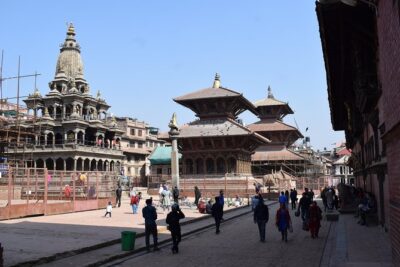
Full-Day 7 UNESCO Tour with Lunch – Private/Group
Read our review →
Kathmandu Private Sightseeing Tour | UNESCO World Heritage Sites
Read our review →Browse the lists this tour appears in