
Reviewed · ANNAPURNA BASE CAMP TREKS
Annapurna Base Camp Trekking
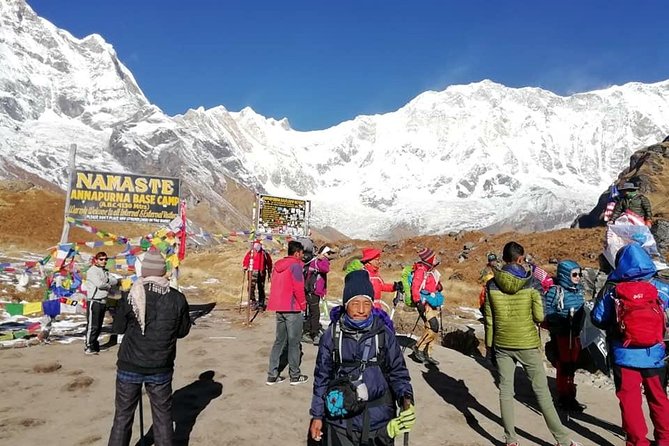
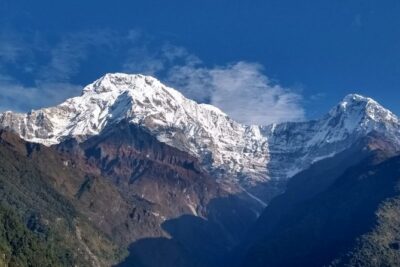
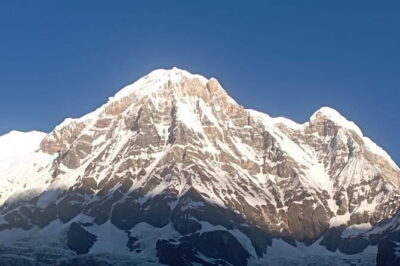
Annapurna Base Camp is the prize here, but the route earns its keep long before you reach the mountain amphitheater. You’ll pass Magar and Gurung villages, climb stone steps through rhododendron forest, watch sunrise from Poon Hill, and sleep in simple teahouses on the way to the foot of Annapurna.
I like the private guide and porter setup, especially for a first Himalayan trek. I also like the sensible mix of Kathmandu temples, Pokhara time, Poon Hill, and the base camp itself. The main catch is that this is not a fully all-inclusive holiday: lunches and dinners in Kathmandu and Pokhara, bottled or boiled water, showers, hot drinks, charging, entrance fees, and tips cost extra.
Key points before you book
- Poon Hill adds a sunrise classic: An early climb to 3,210 meters gives you broad views of the Annapurna and Dhaulagiri ranges.
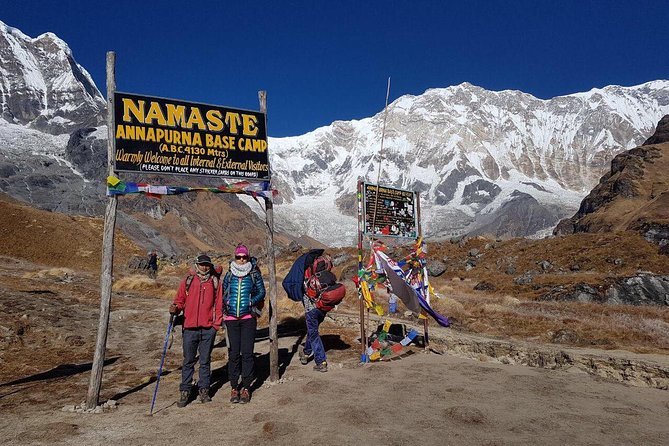
- The route reaches Annapurna Base Camp: You trek through Dovan, Deurali, and Machhapuchhre Base Camp before the final ascent.
- A private English-speaking guide leads your group: The company has assigned guides such as Bishnu Bhatta and Vishnu on past trips, but your guide should be confirmed directly.
- Porters carry shared luggage: The stated arrangement is one porter for every two trekkers, with porter salary, insurance, equipment, food, lodging, and transport covered.
- Most costs are built into the $899 price: Hotels, teahouses, trek meals, permits, tourist buses, airport pickup, guide, and porter are included.
- You need moderate fitness: Expect several hours of walking most days, steep stone steps, early starts, and a high point of about 4,130 meters at Annapurna Base Camp.
What the $899 price really covers
At $899 per person, this trek is priced as a package rather than a simple guided walk. Your airport pickup, three-star hotel stays in Kathmandu and Pokhara, tourist coach between the two cities, trekking permits, guide, porter, and teahouse accommodation are included.
During the trek, breakfast, lunch, and dinner are included at the teahouses. In Kathmandu and Pokhara, the package includes hotel breakfast, but not lunch or dinner. That difference matters. You’ll need a separate food budget in both cities, along with money for drinks and small mountain expenses.
The porter arrangement is a useful part of the value. One porter carries luggage for two trekkers, while the company says the porter’s salary, insurance, equipment, food, lodging, and transport are covered. You’ll still need to pack sensibly, since this is a shared carrying system, not a private porter for every person.
Extra charges include bottled or boiled water, tea, coffee, hot water, showers, battery charging, laundry, phone calls, beer, bar bills, and other drinks. Sightseeing entrance fees in Kathmandu are also excluded. Tips for the guide and porters are not included, so plan for those separately.
There is also a practical timing issue. The experience is described as about 14 days in the day-by-day plan, while the overview calls it a 15-day tour. The listed schedule runs from arrival in Kathmandu through the return drive from Pokhara, so ask the operator to confirm the exact number of hotel nights before you pay.
More Annapurna Base Camp treks:
- Annapurna base camp trek 5 Days
★ 5.0 · 252 reviews - Annapurna Base Camp Trek
★ 5.0 · 111 reviews - Kathmandu to Annapurna Base Camp (ABC) 5-Day Trek
★ 5.0 · 102 reviews
Kathmandu begins with four major cultural sites
Your first day is simple: airport pickup and transfer to your Kathmandu hotel. That is useful after a long international flight, particularly because the company representative handles the airport arrival rather than leaving you to arrange a taxi on your own.
Day two is a full sightseeing day around the Kathmandu Valley. You visit Pashupatinath Temple, Boudhanath Stupa, Patan Durbar Square, and Swayambhunath.
Pashupatinath is one of Nepal’s most important Hindu shrines. The temple complex sits beside the Bagmati River, and the visit gives you an early look at the religious life of the valley. Non-Hindu visitors cannot enter the main temple, but the surrounding area remains an important part of the visit.
Boudhanath is the great Buddhist stupa east of central Kathmandu. Its large white dome and gilded pinnacle make it easy to recognize, but the real pleasure is walking around the stupa and seeing the prayer activity around it. The tour describes it as 36 meters high.
Patan Durbar Square brings you into a former royal center filled with palace buildings, courtyards, pagoda temples, and a museum. Swayambhunath, often called the Monkey Temple, sits on a hill above the valley and provides broad views across Kathmandu. Monkeys are part of the scene, so keep your belongings close.
Entrance fees for these sights are not included. Your guide can help organize the day, but you should carry extra Nepalese rupees for entry charges and small purchases.
The Pokhara transfer takes most of a day
On day three, you leave Kathmandu early. The staff pickup is listed at about 6:30 a.m., with the tourist bus leaving around 7:00 or 7:30 a.m. The drive normally takes about six to eight hours, depending on the schedule and road conditions.
Pokhara is quieter than Kathmandu and sits beside Phewa Lake. It is also the gateway to the trek, with views toward Annapurna, Machhapuchare, Dhaulagiri, Lamjung Himal, and Manaslu when the weather cooperates.
The tourist bus is included, which keeps the cost down, but it is not the quickest or most private way to move between the two cities. If you value time over price, ask if a private vehicle or flight can be arranged, though those alternatives are not part of the stated package.
Nayapul, Ulleri, and the first hard staircase
The actual trek begins after a private vehicle carries you from Pokhara to Nayapul. You walk beside the Modi Khola for about 15 minutes before reaching Birethanti, a large village with shops and teahouses.
The trail then follows the Bhurungdi Khola toward Hille and Tikhedhunga. This first walking day is described as relatively short and easy, but the total time is still about five to seven hours once the drive and uphill sections are counted.
The next day brings the famous climb to Ulleri. The village sits at about 2,070 meters, and the route reaches it by a steep run of stone steps. This is a good place to find out whether your pace is realistic. Take the climb steadily, drink regularly, and avoid trying to match the guide’s speed.
From Ulleri, the trail becomes gentler as it passes through oak and rhododendron forest toward Banthanti and Nangethanti. You finish at Ghorepani, listed at roughly 2,750 to 2,840 meters. The changing altitude is noticeable, but the day’s walking time is only about four to five hours.
More trekking days out of Annapurna Region:
- Annapurna Circuit Trek with Tilicho Lake
★ 5.0 · 368 reviews - Poon hill Trek 3 days
★ 5.0 · 176 reviews - Trekking in Annapurna/Langtang/Everest/Upper Mustang regions
★ 5.0 · 161 reviews - Pokhara: 4-Day Ghorepani, Poonhill & Ghandruk Mountain Trek
★ 5.0 · 132 reviews
Poon Hill gives you the trek’s best early reward
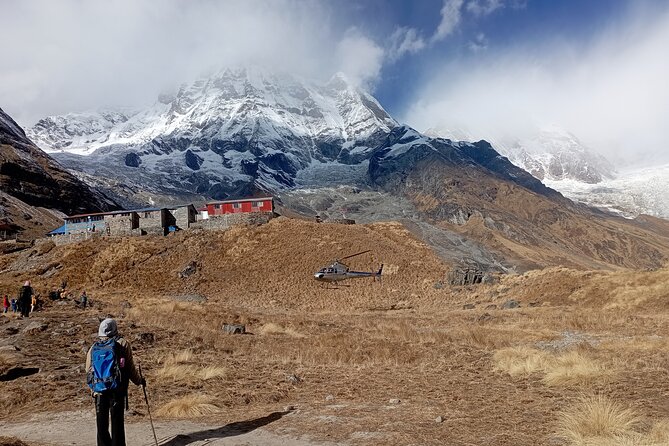
Day six begins before sunrise. You hike for about an hour from Ghorepani to Poon Hill at 3,210 meters. This is one of the strongest features of the route because you get a major mountain viewpoint without waiting until the base camp days.
Poon Hill is known for sunrise views across the Annapurna and Dhaulagiri ranges. On a clear morning, the position also looks toward Mustang, Pokhara, and many high peaks. The description includes a cup of coffee at the viewpoint, followed by a return to Ghorepani for breakfast.
After breakfast, you continue toward Tadapani. The route crosses a ridge and descends through rhododendron forest, with waterfalls along the way. The total day can run six to seven hours, and the combination of an early start plus a second walking section makes it more tiring than the Poon Hill visit alone suggests.
Tadapani sits at about 2,700 meters. The stop is surrounded by forest and mountain views, but the main reason to value it is the route position: it breaks the journey between Ghorepani and Chhomrong.
Chhomrong marks the gateway to the sanctuary
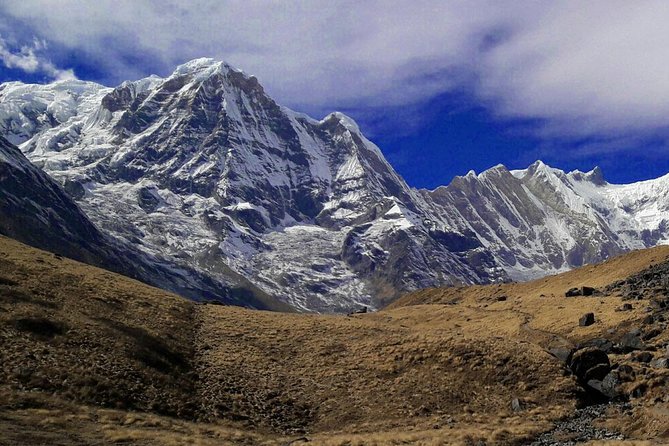
From Tadapani, the trail drops through rhododendron forest and opens onto terraced fields. You pass Gurjung, a Gurung village, cross a suspension bridge, and then tackle more uphill and downhill walking before reaching Chhomrong at about 2,170 meters.
Chhomrong is a key village below the Annapurna massif. It is also where the route begins to feel more remote and more focused on the mountain sanctuary ahead.
The next day leads toward Dovan through damp bamboo forest. The path can be steep, and the forest may feel cold and enclosed. After Himalaya Hotel, the trees open and you see the glacial river below. The route then climbs toward Hinku Cave, descends to a river, and climbs again to Dovan.
The walk to Dovan takes about five to six hours. By this point, you’ll notice thinner vegetation and more open views of cliffs, waterfalls, and the valley. The scenery changes quickly as you gain height, which helps break up the steady physical effort.
Deurali and Machhapuchhre Base Camp prepare you for ABC
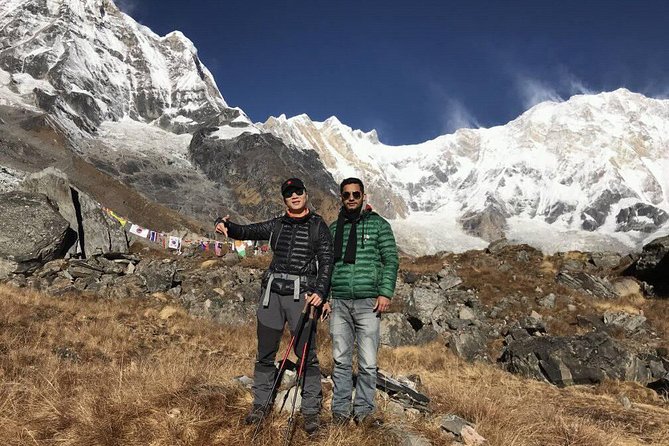
The trail from Dovan to Deurali follows the valley in a steady climb. Some sections cling to rocky cliffs and feel steep, while other stretches flatten briefly before the next rise. The day takes about five to six hours.
The following day is the route’s main target: Annapurna Base Camp. The plan describes five to seven hours of walking, with a rapid ascent from Deurali toward Machhapuchhre Base Camp and then onward to ABC.
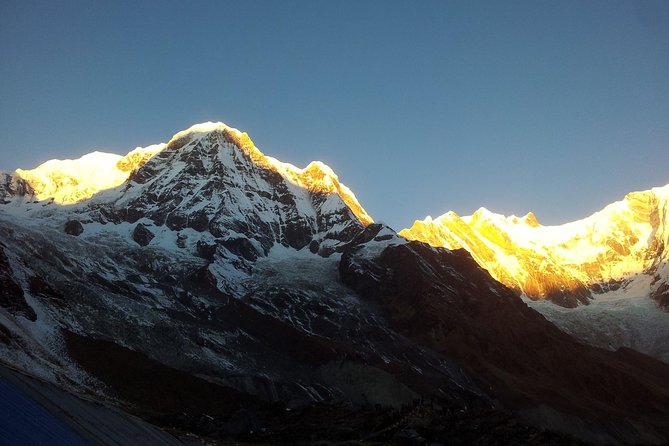
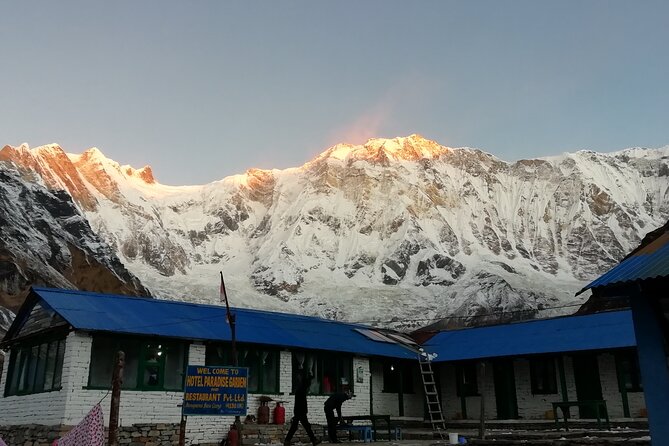
Machhapuchhre, also called Fish Tail, is a dramatic landmark on this approach. The base camp lies within the high mountain sanctuary, surrounded by huge peaks and glacial terrain. This is not a casual viewpoint visit. You’ll be walking at high altitude, and the final ascent can feel demanding after several days on foot.
The tour information gives Annapurna Base Camp as the high point but does not state its exact elevation. Other details list the trek’s highest area as around 4,130 meters in the practical description of the route, so confirm the day’s altitude and overnight arrangements with the company before setting out.
One itinerary line labels day 10 as Deurali, even though the detailed schedule places Annapurna Base Camp on that day. The following day is described as the descent to Bamboo. This looks like a day-label error, but it is worth clearing up so you know exactly where you sleep.
The return route is easier on the lungs, not always the knees
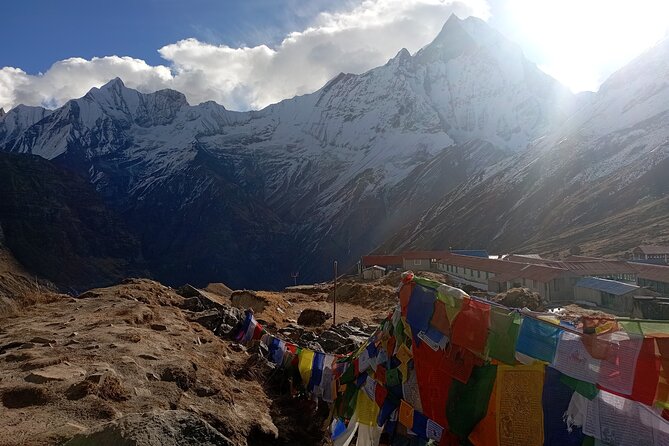
After reaching Annapurna Base Camp, you retrace the route past Machhapuchhre Base Camp, Deurali, Himalaya Hotel, and Dovan before stopping at Bamboo. It is mostly downhill, which helps with altitude, but long descents can be hard on knees and ankles.
The next section continues toward Chhomrong, where you stop for lunch, then drops steeply into the Modi Khola valley. The stone steps near Chhomrong can feel just as tricky on the way down as they did on the way up. Trekking poles would be useful, but the tour information does not state whether they are provided, so ask before departure.
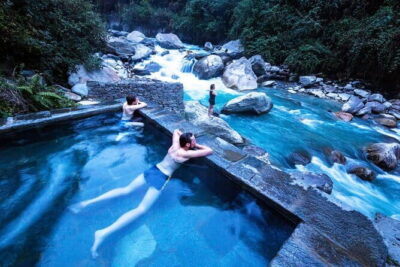
The route then continues toward Jhinu Danda. This is one of the most welcome stops on the return. Jhinu is known for its hot spring, and the plan gives you time to enjoy it after the high mountain walking.
The Jhinu area also brings warmer air, green hills, and a slower final stage. You should still expect about five hours of walking, but the experience shifts from high-altitude exertion to a more relaxed village setting.
Pokhara and Kathmandu finish with long road days
After completing the trek, you walk to Nayapul and drive back to Pokhara. The schedule gives about five hours for this combined section, followed by an overnight in Pokhara.
The next morning, you take a tourist bus back to Kathmandu after breakfast. The drive is listed at seven to nine hours. That is a full day on the road, so do not plan an important international connection immediately afterward without checking the timing carefully.
The package includes airport pickup at arrival, but the information does not clearly promise an airport transfer at the end. Confirm your departure transfer, hotel nights, and the exact final day before booking flights.
The guide and private format matter
This is a private activity, so only your group participates. That gives you more control over walking pace and stops than a large group trek. It also means you should discuss your fitness, preferred pace, food needs, and concerns with the guide from the start.
The company’s past guide names include Bishnu Bhatta and Vishnu. Several accounts connected with the company describe guides who took close care of guests, handled arrangements from airport arrival onward, and adjusted plans when weather interrupted progress. One account specifically described a trek that could not continue to base camp because of weather, an important reminder that mountain plans depend on conditions.
That flexibility is valuable, but it is not a promise that every group will reach ABC in every season. Ask what the backup plan is if snow, rain, landslides, or health problems stop the trek. Also ask who your guide will be, since the guide’s name is not fixed in the tour details.
The moderate fitness requirement should be taken seriously. You’ll walk five to seven hours on many days, climb steep steps, descend rocky paths, and spend several nights gaining altitude. You do not need technical climbing skills based on the information provided, but you do need steady walking fitness and the ability to handle basic teahouse conditions.
Who should book this Annapurna trek
I’d recommend this trip to a first-time Nepal trekker who wants the major Annapurna experiences without planning every permit, hotel, transfer, guide, and porter alone. It also suits a small private group that values personal attention and wants some flexibility.
The package is less suitable if you want luxury, private transport throughout, or every meal and drink included. Kathmandu and Pokhara dinners are extra, mountain water costs extra, and teahouse lodging is practical rather than polished.
The strongest reasons to choose it are the private format, the included porter, the Poon Hill sunrise, the cultural day in Kathmandu, and the chance to reach Annapurna Base Camp for $899. The main things to clarify are the 14-day versus 15-day length, the day-number errors, final airport transport, guide assignment, entrance fees, and the exact plan for weather delays.
Final verdict: a strong value for prepared hikers
You should book this trek if you want a well-supported route to Annapurna Base Camp and are comfortable with early mornings, long bus rides, stone steps, simple teahouses, and extra daily spending for drinks and city meals.
I would not book it without first confirming the schedule in writing. Once those small uncertainties are settled, the package offers a sensible mix of Nepal’s great sights: Kathmandu’s sacred sites, Pokhara’s lake setting, Poon Hill sunrise, Gurung and Magar villages, rhododendron forest, Jhinu hot springs, and the high mountain sanctuary itself.
FAQ
How long is the Annapurna Base Camp tour?
The tour is described as approximately 14 days in the itinerary and 15 days in the overview. Ask the provider to confirm the exact duration, number of nights, and final departure date before booking.
What is the tour price?
The listed price is $899 per person.
Is this a private tour?
Yes. Only your group participates in the activity.
What level of fitness is required?
A moderate level of physical fitness is required. Walking days generally take about four to seven hours, with steep climbs, descents, stone steps, and high-altitude trekking.
Is a guide included?
Yes. An experienced English-speaking trekking guide is included. Guide names associated with the company include Bishnu Bhatta and Vishnu, but you should confirm your assigned guide before departure.
Are porters included?
Yes. The stated arrangement is one porter for every two trekkers. Porter salary, insurance, equipment, food, lodging, and transport are included.
Are meals included?
Breakfast is included at the Kathmandu and Pokhara hotels. Breakfast, lunch, and dinner are included during the trek. Lunch and dinner in Kathmandu and Pokhara are not included.
What transportation is included?
Airport pickup, a tourist coach between Kathmandu and Pokhara, and the private vehicle transfer between Pokhara and Nayapul are included in the stated plan. The return from Nayapul to Pokhara is also included as part of the trek schedule.
Are sightseeing entrance fees included?
No. Entrance fees for the Kathmandu sightseeing sites are not included. You should also budget for drinks, bottled or boiled water, hot water, showers, laundry, charging, phone calls, bar bills, and tips.
Just added around Annapurna Region
- 4 Day Mardi Himal Base Camp Trek from Pokhara★ 5.0 · 18 reviews
- 7-Day Trek to Annapurna Base Camp from Pokhara★ 5.0 · 12 reviews
- Private 4 Day Poon Hill Trek from Pokhara★ 5.0 · 16 reviews
- Annapurna Base Camp Trek from Pokhara and Kathmandu★ 5.0 · 7 reviews
- 6 days Annapurna Basecamp Trek★ 5.0 · 16 reviews
- “Exclusive Round-Trip Transfer: Pokhara to Jomsom & Muktinath”★ 5.0 · 11 reviews
- Poon Hill Ghandruk Circuit Trek from Pokhara 4 Days★ 5.0 · 10 reviews
- Pokhara: Poon Hill Ghorepani Short Trek★ 5.0 · 6 reviews
Annapurna Base Camp Treks, compared.
Kathmandu to Annapurna Base Camp (ABC) 5-Day Trek
Read our review →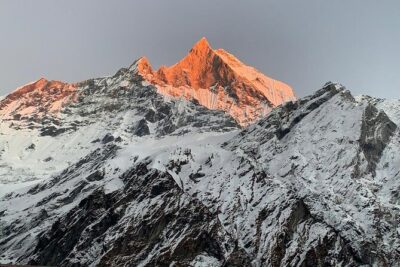
Kathmandu/Pokhara: 5-Day Annapurna Base Camp (ABC) Trek
Read our review →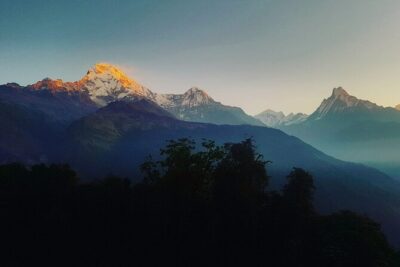
11-Day Hike Tour to Annapurna Base Camp Bliss in Kathmandu
Read our review →Browse the lists this tour appears in