
Reviewed · HIKING & TREKKING
Mera Peak Climbing
Mera Peak gives you a serious Himalayan summit without the scale of an Everest expedition. At 6,476 meters, it is officially Nepal’s highest permitted trekking peak, with views toward Everest, Lhotse, Makalu, Cho Oyu, and Kanchenjunga. You also get time in the quieter Hinku and Hongu valleys, far from the busiest paths around Everest.
I like the tea house and camping combination, which gives you local contact where settlements exist and a more remote mountain experience higher up. I also like the practical support: climbing permits, an experienced guide, and necessary climbing gear are included. Guides named in past trips include Dandee, Sonam Sherpa, Samdu, Dende, Ming-ma, and Gelchen Sherpa.
The catch is simple: this is not a sightseeing holiday with a summit conveniently attached. You need strong physical fitness, careful acclimatization, and patience when weather changes plans. The advertised price is $3,000 per person, but personal climbing equipment, tips, personal costs, international flights, and departure tax are extra.
Key points at a glance
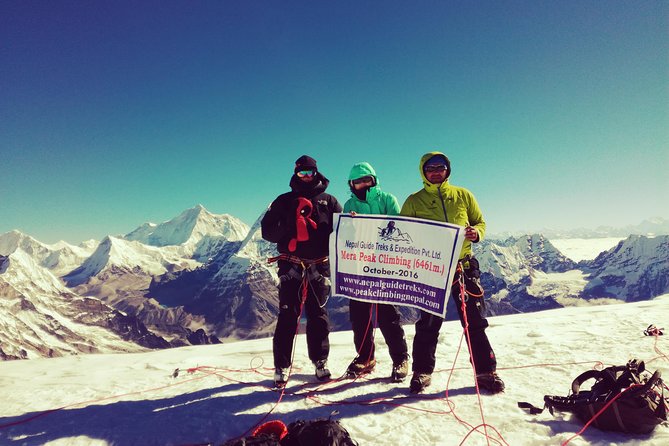
- A 6,476-meter objective: Mera Peak is Nepal’s highest permitted trekking peak, making it a serious first Himalayan climbing goal.
- Six 8,000-meter views: The route promises views toward Everest, Lhotse, Makalu, Cho Oyu, and Kanchenjunga, plus other peaks in the Everest region.
- Remote valley trekking: The Hinku and Hongu valleys offer a wilder setting than the main Everest route.
- Mixed accommodation: You use tea houses lower down and camping in more remote sections.
- Small-group format: The maximum group size is 15 people, useful for a technical trip where guides need to watch conditions closely.
- Altitude comes first: Water, rest, food, medical advice, and a willingness to descend are not side issues. They are part of the climb.
Why Mera Peak is a sensible first Himalayan climb
Mera Peak sits in the Everest region, but this program is not simply an Everest Base Camp walk with a higher viewpoint. You are aiming for a permitted trekking peak at more than 6,000 meters, where thin air, cold, snow, and fatigue can change the character of every hour.
That makes Mera attractive for someone who wants a real mountaineering goal without signing up for an expedition on an 8,000-meter giant. You still need preparation and proper judgment, but the climb is presented as an 18-day program rather than a rushed dash from Kathmandu.
The views are a major reason to come. From the Mera area, you may see Everest at 8,848 meters, Lhotse at 8,516 meters, Makalu at 8,485 meters, Cho Oyu at 8,201 meters, and Kanchenjunga at 8,586 meters. The description also refers to several other peaks inside the Everest region, so the reward is not limited to one summit photograph.
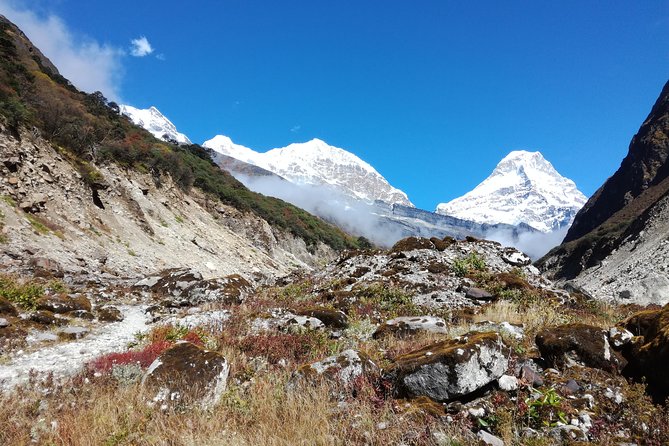
I especially like the route’s setting in the Hinku and Hongu valleys. These valleys are described as wild, beautiful, and uninhabited in sections. That matters because the experience is not just about reaching a summit. It is also about moving through a quieter Himalayan region and seeing highland Sherpa culture in communities along the way.
More trekking days out of Everest Region:
- Everest Base Camp Trek – 14 Days
★ 5.0 · 1,499 reviews - Everest Base Camp Trekking
★ 5.0 · 485 reviews - Everest Base Camp Trekking – 13 Day
★ 5.0 · 365 reviews
What the 18-day program actually includes
The total duration is listed as approximately 18 days, 2 hours, and 5 minutes. That unusually exact figure should not be taken as a promise that every transfer and mountain day will run to the minute. In Nepal, weather and mountain conditions can affect plans, especially around flights, passes, and summit attempts.
The available schedule identifies Nepal Guide Treks and Expedition as the stop and meeting point, but it does not provide a detailed day-by-day breakdown. You should ask for the full route plan before paying, including the walking days, acclimatization days, summit schedule, and return arrangements.
What you do know is useful:
- You receive four nights in Kathmandu on a bed-and-breakfast basis.
- The mountain section combines tea house lodging and camping.
- A Mera Peak climbing permit is included.
- Food and accommodation during the trek are included.
- An experienced trekking and climbing guide is included.
- Necessary climbing gear is included.
This is enough to understand the shape of the trip, but not enough to know the exact villages, camp elevations, walking hours, or summit-day timetable. For a high-altitude climb, those details matter. Get them in writing.
Kathmandu: four nights to prepare, not just sleep
The program begins with pickup at Tribhuvan Airport in Kathmandu. Four nights in the city are included with breakfast, giving you time to recover from the flight, organize equipment, and meet the team before heading into the mountains.
Kathmandu is also where you should check every piece of personal gear. The company includes necessary climbing gear, but personal climbing gear is excluded. That phrase can mean different things from one operator to another, so ask exactly what is supplied and what you must bring.
You should also use the Kathmandu time to discuss altitude, medical concerns, and the route. The trip is limited to 15 people, which is a reasonable maximum for a climb where group pace and health checks matter. Still, group size does not remove the need to understand your own responsibilities.
Breakfast is included in Kathmandu, but personal expenses are not. Budget for meals beyond the included arrangement, drinks, snacks, equipment purchases, communications, and tips. International airfare and departure tax are also outside the $3,000 price.
Through the Hinku and Hongu valleys
The most appealing part of this program may be the route away from the main crowds. Hinku and Hongu are presented as remote valleys, with sections described as wild and uninhabited. That means you should expect a stronger feeling of isolation than on a standard tea house circuit.
You will see highland Sherpa communities and their traditions along the settled parts of the route. This cultural element gives the climb some depth. The trip is not only a test of legs and lungs, but also a chance to understand how communities live at high altitude.
Accommodation changes with the terrain. Tea houses provide basic lodging and meals where settlements support them. Camping takes over in more remote sections, where there may be no lodge infrastructure. That combination is practical, but it also means comfort will vary. You should be ready for simple facilities, changing meal choices, and nights where the mountain setting matters more than convenience.
The food plan covers the trek, yet you should still carry useful personal snacks if you need familiar calories. The health guidance specifically recommends light food that is high in calories, along with ginger and garlic. That is sensible advice for long walking days, but it does not replace telling your guide if you are unable to eat or keep food down.
More to do in the Everest Region:
- Everest Base Camp Helicopter Tour landing at Everest View Hotel
★ 5.0 · 668 reviews - Everest Base Camp Trek -14 Days
★ 5.0 · 321 reviews - Everest Base Camp Helicopter Tour landing at Hotel Everest View
★ 5.0 · 218 reviews - Everest Base Camp Trekking – 2025/2026
★ 5.0 · 199 reviews
Altitude safety is the central issue
The strongest part of the practical advice is that it treats altitude sickness seriously. You are told to drink two to three liters of lukewarm water a day, avoid alcohol and smoking, eat light high-calorie food, and sleep sufficiently.
If symptoms are mild, the guidance says to remain where you are, rest, drink water, and avoid panic. You should discuss your condition with your guide and consult a doctor if one is available. If you do not improve after acclimatizing, you should descend. If the condition is serious, you should descend immediately.
That last point deserves emphasis. A summit goal is never more important than your health. The advice also mentions Diamox and a Gamow bag, a high-pressure inflatable bag used to help restore oxygen levels and air pressure. You should not assume these items will be available. Confirm in advance what altitude equipment the company supplies.
The program’s own advice says to check whether the organizer provides all altitude gear. Do that before departure, not when you are already above the tree line. Ask about emergency evacuation arrangements, medical supplies, oxygen, communication, and the procedure for changing the plan.
Several past climbs had to deal with snow, poor weather, delays, or route changes. One planned Mera Peak and Amphu Laptsa Pass itinerary could not continue through the pass after heavy snowstorms in late October. The useful lesson is not that every trip will face the same problem. It is that flexibility is part of Himalayan climbing.
The summit attempt and the value of good judgment
A Mera Peak summit day is likely to be the hardest part of your program, though the exact timetable and route are not provided. By that point, you will have spent many days walking, sleeping at altitude, and adapting to colder conditions.
The company’s past guiding teams include Dandee, Sonam Sherpa, Samdu, Dende, Ming-ma, and Gelchen Sherpa. The personal accounts associated with those climbs describe guides helping with route changes, health decisions, weather delays, and summit planning. You should still ask which guide will lead your own group, what climbing qualifications that person holds, and how guide-to-climber ratios are handled.
One particularly important detail is that a guide allowed a climber with stomach illness to make a summit attempt after assessing the person’s condition and ability. That should not be read as permission to climb while sick. It shows why a good guide must judge the individual rather than simply push the whole group forward.
Another account describes a guide helping make a safe decision when a climber’s companion became unwell. That is exactly the kind of support you need at altitude: clear advice, no false bravado, and a willingness to change the plan.
A successful summit is wonderful, but it is not guaranteed. Weather can close routes, snow can make passes unsafe, and altitude can affect even fit people. Book this with the understanding that safety decisions may mean turning around.
What $3,000 buys you
At $3,000 per person, the cost looks reasonable for an 18-day guided peak program if you value organization and included support. The package covers four Kathmandu nights, the Mera Peak permit, trek food and lodging, a guide, and necessary climbing gear.
The tea house and camping arrangement also reduces the need for you to organize separate mountain logistics. For a first 6,000-meter climb, that support can be worth more than trying to assemble every part yourself.
But the price is not all-inclusive. International flights and departure tax are excluded. Personal climbing gear, personal expenses, and tips for guides and porters are also excluded. You should price those extras before deciding if the trip fits your budget.
The best value comes if you want one company handling the main framework while you focus on walking, acclimatizing, and climbing. The value is weaker if you already own a full mountaineering kit and prefer to arrange every lodge, permit, and transport detail yourself.
Who should book this climb?
You should consider this program if you are at least 18, physically strong, comfortable with a demanding high-altitude objective, and willing to follow a guide’s safety advice. You should also enjoy simple lodging and accept that plans may shift.
It suits someone who wants more than a standard Himalayan trek but is not looking for an 8,000-meter expedition. It is also a good fit if you want a small-group setting and support with permits, food, accommodation, and climbing equipment.
It is not a good choice if you want guaranteed summit success, fixed timing, luxury accommodation, or an easy introduction to Nepal. The description specifically requires strong physical fitness, and the altitude advice makes clear that this is a serious trip.
The company has a strong record of recommendations, with a listed rating of 5 from 33 reviews and 100 percent recommending it. More useful than the numbers is the pattern behind them: past climbs involved responsive communication, help with logistics before and after the climb, and sensible adjustments when weather or health caused trouble.
Booking details and cancellation
Pickup is offered from Tribhuvan Airport in Kathmandu, and the meeting point is listed there. Mobile tickets are available, confirmation is received at booking, and the experience runs Monday through Sunday from 9:45 a.m. to 6:15 p.m. according to the stated operating information.
The maximum group size is 15. The minimum age is 18, and the activity is near public transportation in Kathmandu.
Cancellation is free if you cancel at least 24 hours before the local start time. Cancellations made less than 24 hours before the start, or changes made inside that period, are not accepted for a refund.
Should you book Mera Peak Climbing?
I would book this if you want a genuine 6,000-meter goal, value strong logistical help, and can prepare seriously for altitude. The combination of remote valleys, Sherpa communities, high mountain views, included permits, and mixed tea house and camping accommodation gives the trip more character than a simple summit transfer.
Before booking, request the detailed day-by-day itinerary and a written list of included climbing gear. Ask who will guide your group, how altitude emergencies are handled, and what happens if weather closes a route.
Book with the right expectations. You may get the summit, but the best measure of a successful Mera Peak trip is reaching the decision point well prepared and returning safely. If that sounds like the kind of adventure you want, this program offers a practical route into serious Himalayan climbing.
FAQ
Where does Mera Peak Climbing start?
The meeting point is Tribhuvan Airport in Kathmandu, Nepal. Pickup is offered.
How long is the experience?
The listed duration is approximately 18 days, 2 hours, and 5 minutes.
What is the price?
The listed price is $3,000 per person.
Is Mera Peak climbing suitable for children?
No. The minimum age is 18.
How fit do I need to be?
You should have a strong physical fitness level. The program involves high-altitude trekking and climbing.
What accommodation is included?
You receive four nights in Kathmandu with breakfast and accommodation in tea houses and camps during the trek.
Is climbing equipment included?
Necessary climbing gear is included, but personal climbing gear is not. Ask the organizer for the exact equipment list.
What happens if I need to cancel?
You can receive a full refund if you cancel at least 24 hours before the experience start time. Cancellations or changes made less than 24 hours before the start are not accepted.
Just added around Everest Region
- Day Tour to Everest Base Camp By Helicopter★ 5.0 · 16 reviews
- Kathmandu To Lukla By Helicopter Flight★ 5.0 · 6 reviews
- Luxury Everest Base Camp Trek – 11 Days★ 5.0 · 9 reviews
- Everest Base Camp Tour & View Point by Helicopter from Katmandu★ 5.0 · 3 reviews
- Everest base camp helicopter tour with Guarenteed Landing★ 4.0 · 7 reviews
- Everest base camp flight over by Helicopter from Kathmandu★ 5.0 · 10 reviews
- Everest Base Camp Helicopter Tour Stop at Hotel Everest View.★ 5.0 · 17 reviews
- Everest Base Camp Helicopter Tour★ 5.0 · 24 reviews
Hiking & Trekking, compared.
Nagarkot Sunrise View and Day Hiking from Kathmandu
Read our review →
Browse the lists this tour appears in