
Reviewed · WORKSHOPS
Knife (Khukuri) Making Workshop- Forge of the Gurkhas
The most memorable part of this Kathmandu workshop is watching a plain piece of steel become a real khukuri, not a decorative trinket from a souvenir stall. At Indra’s home forge, you help hammer the metal, shape the blade, and polish the finished knife. The work is hot, noisy, smoky, and refreshingly far from a polished tourist showroom.
I like two things especially: the small group limit of five, which gives you time at the anvil, and the personal setting. Guides such as Swoyam and Namrata help with translation and conversation, while Indra brings decades of blacksmithing skill. You also leave with the knife you helped make, not just a photograph of someone else’s craft.
The main caution is that this is a hands-on demonstration with safety limits, not a fully independent blacksmithing class. The host controls the most dangerous grinding and sharpening, and the workshop can run four to five hours. Children may lose patience, and you need to handle the cancellation and pickup details carefully.
Key points before you book
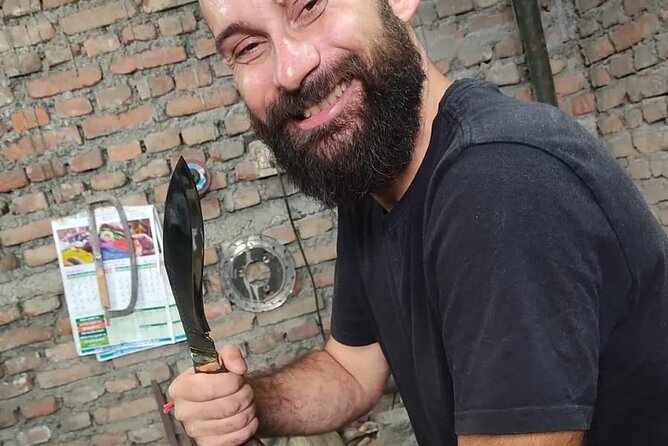
- You make a small khukuri from raw steel: The included knife is described as roughly six inches, with larger versions available for an extra charge according to workshop arrangements.
- Indra does the precision work: His more than 40 years of blacksmithing experience show in the hammering, shaping, heat control, and finishing.
- You visit a working home forge: This is a rustic, personal setting rather than a formal craft center or factory.
- You take part without taking unsafe risks: You can hammer the metal and help with early grinding, while the host handles the most hazardous blade work and sparks.
- Hotel pickup is offered: Guides have collected participants in Thamel and arranged transport to the workshop.
- The knife is a useful souvenir: You go home with a sharp, personalized khukuri made during your visit.
Why a khukuri workshop feels different from shopping for one
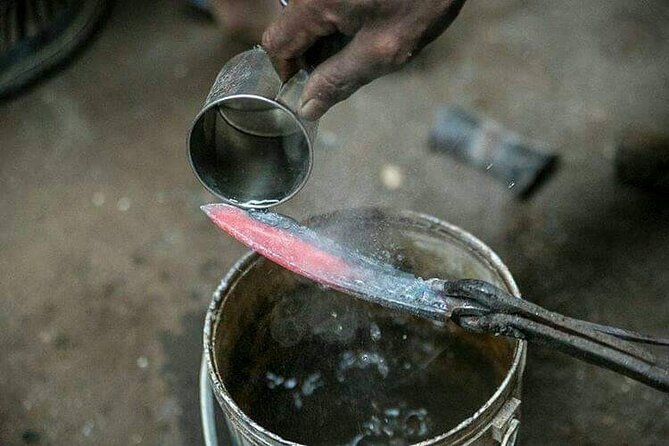
The khukuri is more than a curved knife associated with Gurkha soldiers. In Nepal, it is also a practical tool used for jobs such as shaping timber and cutting meat or vegetables. Its traditional design includes a curved, tempered-steel blade, a wood or buffalo-horn handle, and a wooden-and-leather scabbard.
The small notch near the handle has practical and symbolic meaning. It helps keep blood from running toward the handle, and it is also linked with the Hindu Trinity of Brahma, Vishnu, and Shiva. You do not need to be a knife enthusiast to appreciate the design, since the workshop explains how a working tool carries cultural meaning.
I find the strongest part of the activity is the change in your sense of value. A shop-bought knife can look impressive, but after several hours of hammering, grinding, polishing, and waiting for the craftsperson to make corrections, you see why a well-made khukuri takes skill. The souvenir becomes a record of time spent with a Nepali family and artisan.
The workshop uses recycled steel in some cases, including old truck suspension springs. That detail gives the activity a practical character. You are not simply decorating a prepared blank. You are watching old metal become something useful again.
More classes and workshops in Kathmandu:
- Half day cooking class in Thamel kathmandu
★ 5.0 · 607 reviews - Kathmandu: Local Women-Led Nepali Cooking & Momo Class
★ 4.9 · 360 reviews - Kathmandu: Local Lead Nepali Cooking & Momo-Making Class
★ 5.0 · 212 reviews
Leaving Kathmandu for Indra’s home forge
The activity lasts about four hours, though accounts of the workshop place some sessions closer to four and a half or five hours. Pickup is offered, and the guide may meet you at your hotel in the Thamel area before taking a taxi toward the hills and a more remote part of Kathmandu.
The ride matters because the workshop is not presented as a standard city attraction. You leave the area of souvenir shops and hotels and head to a working neighborhood where the blacksmith’s home and forge are part of daily life. The setting can be rustic, so you should arrive ready for a practical work area rather than a clean, staged studio.
Guides make the journey useful by talking about Nepal, local places, and customs. Swoyam has helped with translation and provided background during the ride, while Namrata has accompanied participants and handled interpretation. The guide is important here because the blacksmith’s work moves quickly, and clear translation helps you understand both the process and the conversation.
The group maximum is five people. That is a good size for a forge: small enough to see the anvil and ask questions, but large enough to share the activity with family or friends. If you are booking for children, keep the time in mind. A family with children aged four and six found that the younger participants eventually ran out of patience during the long process.
Meeting Indra and seeing a working coal forge
At the forge, you meet Indra, a blacksmith with more than 40 years of experience. His work is the heart of the activity. He may have an apprentice or family members helping, which gives you a look at how the craft is passed on within the household.
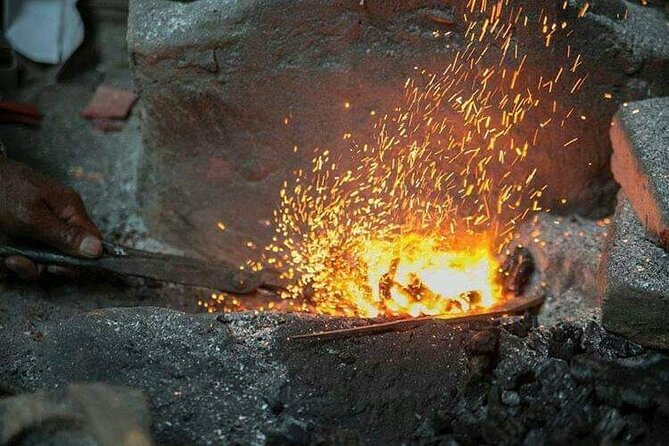
The forge has been described as primitive and equipped with far less machinery than many modern workshops. That is part of its appeal, but it also explains why the process takes time and why the finished blade depends so heavily on the maker’s judgment. Indra’s control of the hammer is one of the things to watch closely. He can read the metal in a way a first-time maker cannot.
You will likely be offered tea, and lunch has been included in some sessions. These touches help the visit feel social rather than purely instructional. The workshop also gives you time to meet the family and see a slice of home life, though the exact meal and hospitality may depend on the day.
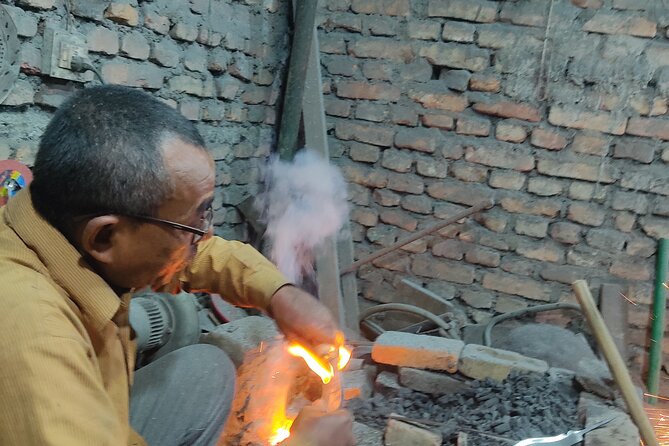
Do not expect a quiet classroom. You may encounter heat, metal dust, smoke, sparks, and the steady sound of hammering. Wear clothes and shoes suitable for a working forge. The supplied information does not specify a dress code, but practical clothing is the sensible choice.
Hammering the steel into a blade
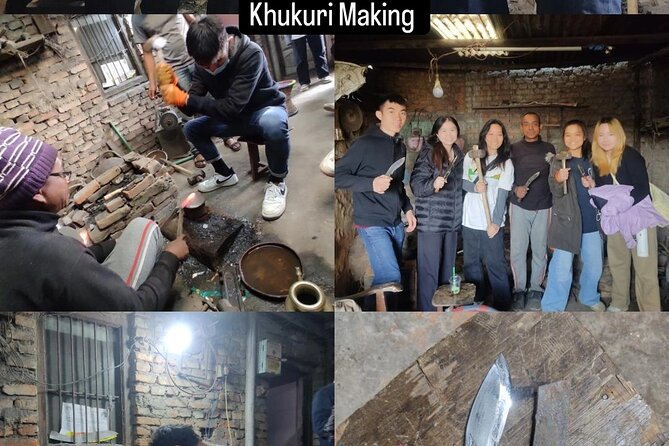
Your first major task is hammering the iron or steel. The raw piece is heated and worked into the curved shape associated with a khukuri. You do not need years of strength or technical training, since Indra guides the process and helps control the work.
This is the most satisfying stage for many people because the change is easy to see. A flat, rough piece of metal begins to look like a blade under repeated blows. You get a direct feel for the force and patience involved, while the blacksmith keeps the shape on track.
The workshop is designed to let you do as much as is safe and reasonable. You may hammer the metal yourself, then hand it back to Indra for correction and refinement. His apprentice can help if you need a break, which is useful because the physical work and heat can become tiring.
There is also an important limit. A first-time maker will not produce a flawless knife alone in a few hours. Indra’s eye and hand determine the final shape, balance, and quality. That is not a weakness of the activity. It is an honest look at how much skill sits behind a finished khukuri.
More days out in Kathmandu:
- Private Kathmandu Sightseeing Tour | UNESCO World Heritage sites
★ 5.0 · 756 reviews - Nagarkot Sunrise View and Day Hiking from Kathmandu
★ 5.0 · 471 reviews - Kathmandu: Full Day 7 UNESCO Tour with Lunch – Private/Group
★ 5.0 · 415 reviews - Private Bhaktapur and Nagarkot Day Tour From Kathmandu
★ 5.0 · 305 reviews
Grinding, buffing, and the safety boundary
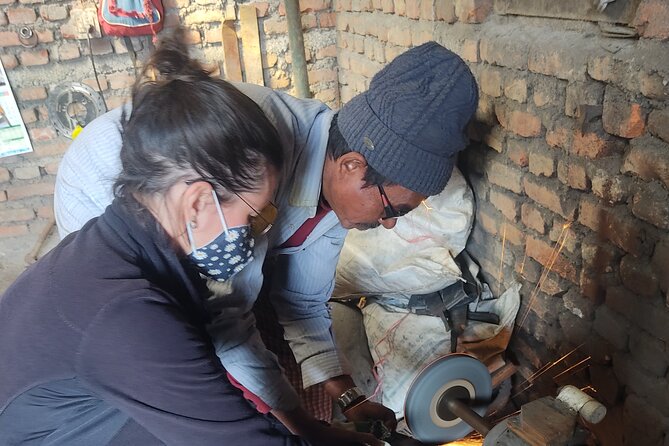
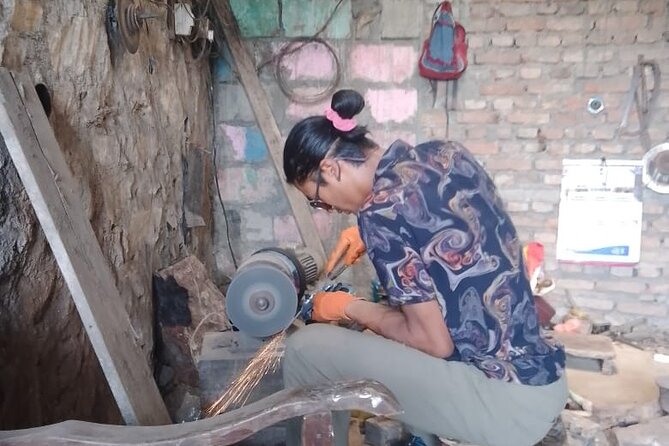
After hammering, the blade needs grinding and shaping. Some descriptions of the workshop say you take part in the first grinding, and several accounts describe participants using a grinding wheel. At the same time, the safety instructions make clear that the host handles the blade grinding that creates the most dangerous sparks.
In practical terms, you may get a chance to help with an early or supervised part of the grinding, but you should not expect to operate every machine or sharpen the blade independently. The host may take over whenever the wheel, sparks, or blade position creates a risk.
Stay clear of the sparks and follow the instructions without trying to force more participation. This is one of the few times when watching is better than doing. You can still see the rough blade become smooth and defined, and you avoid turning a cultural activity into an avoidable accident.
The final stages include buffing and polishing. Here, the knife begins to look finished. The surface becomes brighter, the edge is refined, and the handle is fitted. In some sessions, participants have been able to personalize the knife, so you can ask the guide what options are available on the day.
The finished blade can be extremely sharp. Handle it carefully, especially when packing it for the journey home. The activity provides a scabbard as part of the traditional khukuri design, but you should still ask the guide about safe transport and any rules that apply to your onward journey.
What you actually take home
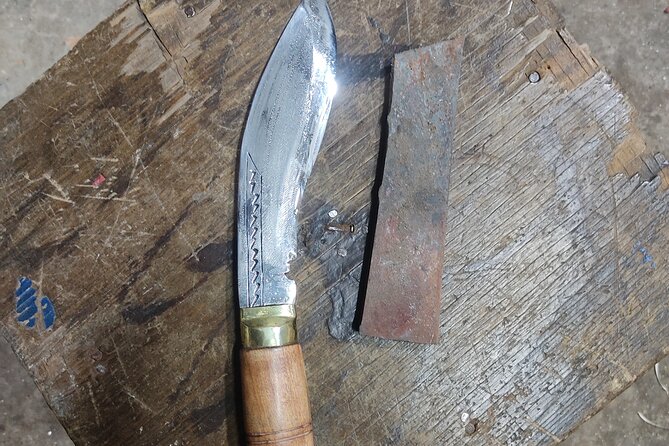
The standard workshop includes a small khukuri, described as approximately six inches. That size makes sense for a souvenir because it is easier to handle and carry than a large fighting or agricultural blade.
Some participants have arranged a 10-inch khukuri for an additional fee. If size matters to you, confirm the available options and added cost before the forge work begins. The supplied price of $68 per person covers the listed workshop, but it should not be assumed to include upgrades.
The knife is not necessarily identical from one session to the next. A handmade item can show small differences in the handle, finish, and surface. That is part of the point. You are taking home a tool shaped in a real forge, not a mass-produced item with an artificial handmade label.
There is one quality issue worth keeping in mind. Cracks have appeared in some blades during the making process. The provider has said that a replacement knife can usually be made and delivered when this happens, but you should inspect your knife before leaving and ask the guide what will happen if a defect appears later.
That small risk does not erase the value of the workshop, but it is a reason to keep realistic expectations. The experience is strong even when a piece of steel needs to be remade. You are paying for the craft session and the finished souvenir, not a factory guarantee.
Is $68 a fair price?
At $68 per person, the price is reasonable if you value the full visit rather than just the knife. The fee combines roughly four hours of instruction and demonstration, hotel pickup offered within the service area, translation, use of the forge and tools, the small khukuri, and the chance to meet a working blacksmith at home.
A shop knife may cost less, especially if you compare only the object. But that comparison misses the main benefit. You spend time learning how the blade is formed, taking part in the work, and seeing the pride attached to a traditional craft. The personal connection gives the knife meaning that a quick purchase usually lacks.
The value is also stronger for anyone who enjoys making things. You do not need previous blacksmithing experience, and most people can take part. If you want a polished museum-style demonstration with no heat, dirt, or waiting, this is not the right use of your money.
The group limit of five helps protect the price. You are not one face in a large class. The guide and blacksmith can give attention to the work, translate questions, and adjust the amount of participation. For a private or small family booking, that makes the fee easier to justify.
Who will enjoy this four-hour activity
I would recommend the workshop to you if you like local crafts, working tools, family-run experiences, and souvenirs with a story. It is especially good for anyone who has already seen Kathmandu’s major temples and wants an activity that brings you into contact with a living skill.
It suits couples, small groups, and solo participants. The guide can fill in cultural details during the ride and help you talk with Indra. The small group also means you are not waiting behind a crowd for a single turn at the anvil.
It is less suitable if you have limited time, dislike heat and noise, or want a quick activity. Four hours is an important commitment in Kathmandu, and traffic can affect the total time around the workshop. The actual craft may also run long when several people are making knives.
Families can book it, but young children need distractions and close supervision. The forge is an active work area, not a children’s play space. Older children who can focus on a slow craft may enjoy it more than very young ones.
The activity is also a good choice for returning visitors who have already bought a khukuri from a tourist shop. Making one gives you a better sense of the metal, the handle, the sharpening, and the work that goes into a reliable blade.
Booking details that can save you trouble
Pickup is offered, but give the provider your exact location promptly. A failed booking involved a pickup point about 40 kilometers from the workshop, which was too far for the normal arrangement. Same-day bookings are especially risky if the provider cannot confirm the location in time.
The cancellation rule is strict: you can receive a full refund if you cancel at least 24 hours before the start time. Cancellations or changes made inside that period are not accepted for a refund.
Most people can take part, and confirmation is provided at booking. The activity has a maximum of five participants. If you need a larger blade, a special pickup point, or a particular guide, ask before the day of the workshop rather than assuming it is included.
You should also allow room in your luggage for the knife and scabbard. Since the blade is sharp, keep it protected and check the rules for your next flight, destination, or border crossing. The workshop information confirms that you take the knife home, but it does not list airline or customs requirements.
Should you book the Forge of the Gurkhas workshop?
Book it if you want a hands-on cultural activity and a useful souvenir with a real connection to Nepal. The strongest reasons are the small group, the home forge, Indra’s long experience, the help from guides such as Swoyam and Namrata, and the chance to see scrap steel become a finished khukuri.
Skip it if you want total control over every step, a short class, or a guaranteed flawless blade made without any waiting. The host must handle dangerous grinding and final sharpening, and occasional cracks may require a replacement.
For most visitors with four spare hours in Kathmandu, I think the workshop earns its place. You leave with more than a knife. You leave understanding why a khukuri is a practical tool, a cultural symbol, and a craft that deserves careful hands.
FAQ
How long does the khukuri-making workshop last?
The activity lasts approximately four hours. Some sessions may take four and a half to five hours, especially when more than one person is making a knife.
How many people can join the workshop?
The maximum group size is five participants.
What size khukuri is included?
The standard workshop includes a small khukuri with a blade of approximately six inches.
Can I make a larger khukuri?
A 10-inch khukuri has been available for an additional fee. Confirm the current upgrade price and availability when booking.
Which parts of the knife-making process can I do?
You can take part in hammering the metal, the first grinding, and the final buffing and polishing. For safety, the host handles the riskiest blade grinding and sharpening work.
Is hotel pickup available?
Yes. Pickup is offered, and guides have collected participants from hotels in Kathmandu, including the Thamel area. You need to provide your pickup location in advance.
What is the cancellation policy?
You can cancel for a full refund up to 24 hours before the scheduled start time. Cancellations or changes made less than 24 hours before the activity are not accepted for a refund.
Just added around Kathmandu
- Traditional Momo Making Class★ 5.0 · 10 reviews
- Women Empowerment Project(Nepali cooking class & jewelry workshop★ 5.0 · 15 reviews
- Manthali Airport (Ramechhap) To Kathmandu – Transport Service★ 4.5 · 11 reviews
- Amazing 1 Day Trekking Experience in Kathmandu Nepal★ 5.0 · 24 reviews
- Walking tour of Kathmandu with awesome local guides★ 5.0 · 4 reviews
- Walking tour of real Kathmandu through back streets.★ 5.0 · 3 reviews
- Kathmandu Street Food Walking Tour – Eat Like a Local★ 5.0 · 3 reviews
- Private Manaslu Circuit Trek at Himalayas★ 5.0 · 3 reviews
Workshops, compared.
Nepalese Momos or Dal Bhat Cooking Class (Cook with Delight)
Read our review →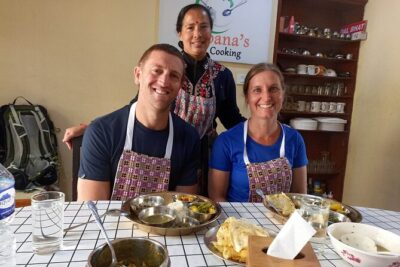
The best Private Nepali Cooking Class in Kathmandu
Read our review →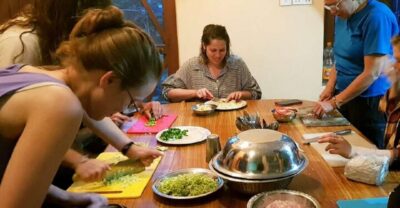
Nepalese Kitchen in Pokhara: Momos or Dal Bhat Cooking Class
Read our review →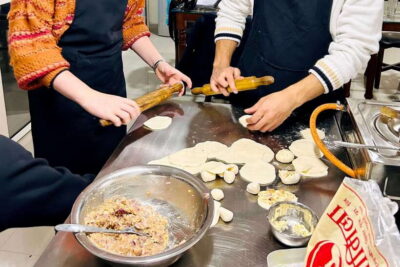
Browse the lists this tour appears in